

49%
49%
of Canadian employees rank stress management as a top workplace priority
Mental health conditions cost the global economy an estimated $5 trillion each year - a figure projected to more than triple by 2030.
Brain health has emerged as one of the defining health, economic, and workforce challenges of the 21st century. Cognitive decline, mental health issues, and stress-related problems now affect millions of people around the world.
But it doesn’t have to be this way.
Growing scientific evidence shows that brain health is shaped not only by genetics or medical care, but by everyday lifestyle choices such as nutrition and the environments in which people live, work, learn, and age.
The workplace represents the single greatest opportunity to support brain health at scale.
Adults spend an average 90,000 hours at work over their lifetime, making workplaces a powerful — and often overlooked — lever for improving mental health, cognitive resilience, and long-term performance.
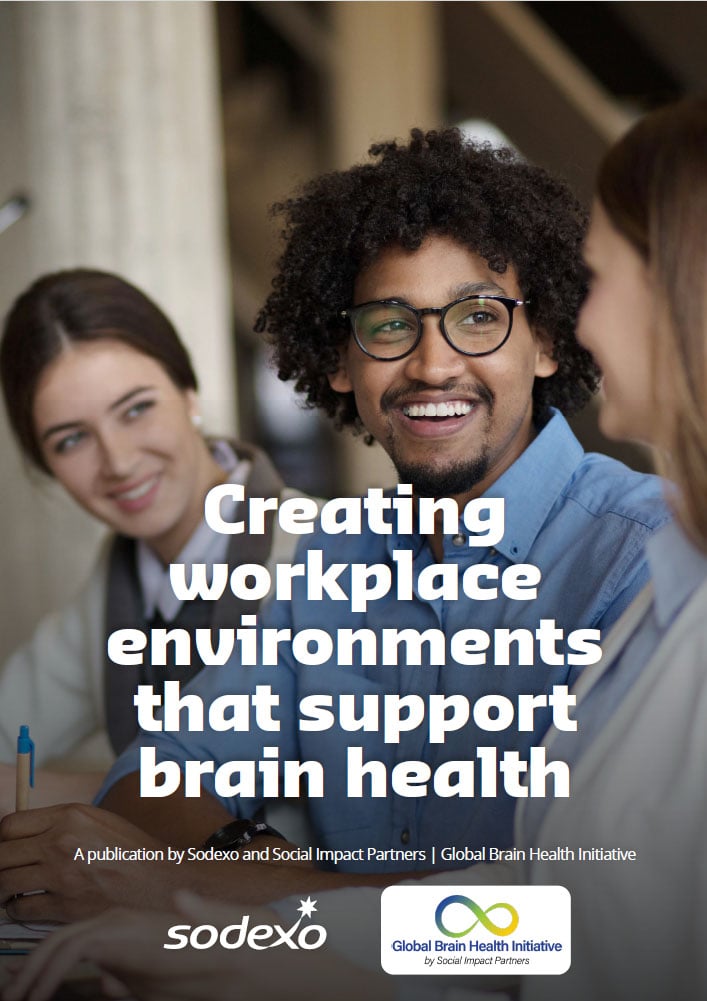
Our new white paper, ‘Creating environments that support brain health’ shows how workplaces, when designed intentionally, can do more than support productivity. They can actively reduce stress, strengthen social connection, encourage healthy behaviors, and help people think clearly, adapt, and thrive.
This white paper was developed by Sodexo, in partnership with Social Impact Partners and the Global Brain Health Initiative.
Across Canada, employees are clear about what they need to perform at their best, and where workplaces are falling short.
According to a survey conducted by Sodexo Canada and Leger, nearly half of employees (49%) rank stress management as a top priority, yet only 26% say their workplace provides strong support in this area. This gap reflects a broader shift, where purpose and meaning (39%) and mental fitness (36%) are now essential drivers of performance.
At the same time, organizations are not always aligned with employee needs. Social connection is the most supported area (33%), despite ranking lower in importance.
The path forward is clear. Half of Canadian employees (50%) want stronger support for stress management, followed by mental fitness (31%). Supporting brain health is becoming a core requirement of the workplace.
The survey was conducted online with 715 Canadian workers aged 18 and over, using Leger’s LEO panel from June 12 to 14, 2026, and results were weighted to reflect the Canadian population.
Building on The Vibrant Mind, this white paper expands the focus from brain-healthy nutrition to a holistic, evidence-based framework for brain health. It translates neuroscience, public health research, and real-world experience into practical guidance for leaders designing workplaces, campuses, healthcare facilities, and senior living environments.
Brain health is more than the absence of disease. It includes the ability to think clearly, regulate emotions, learn, adapt, and remain resilient throughout life.
Cognitive decline, anxiety, depression, burnout, and dementia are connected results of lifestyle, stress exposure, and environmental conditions over time. Nine evidence-based pillars support cognitive function and mental well-being:
These pillars show how everyday environments can actively protect brain health and strengthen cognitive resilience.
Brain health is not a luxury. It is essential to the future of work, learning, and aging — and a shared responsibility for every organization.
Mental health conditions cost the global economy an estimated $5 trillion each year - a figure projected to more than triple by 2030.
Our white paper, ‘Creating Workplace Environments That Support Brain Health’ shows how workplaces, when designed intentionally, can do more than support productivity. They can actively reduce stress, strengthen social connection, encourage healthy behaviors, and help people think clearly, adapt, and thrive.